Showing posts with label Non-fiction. Show all posts

Wednesday, December 11, 2024

A Rome of One's Own: The Forgotten Women of the Roman Empire

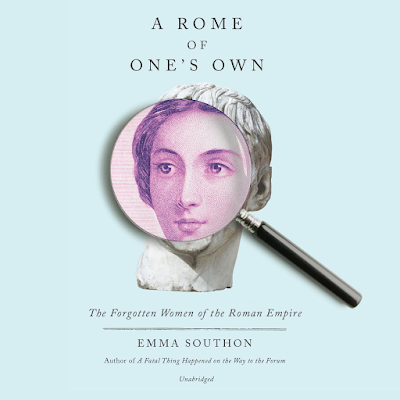
Today's post is on A Rome of One's Own: The Forgotten Women of the Roman Empire by Emma Southon. It is 416 pages long and is publsihed by Harry N. Abrams. The audiobook was read by Danielle Cohen. The cover is light blue with a marble bust in the center and a magnifying glass enlarging the face. The intended reader is someone who likes roman history and women's history. There is foul language, discussion of sex, rape, childbirth, and violence in this book. There Be Spoilers Ahead.

From the back of the audiobook- From the acclaimed author of A Fatal Thing Happened on the Way to the Forum, a wildly entertaining new history of Rome that uses the lives of twenty-one extraordinary women to upend our understanding of the ancient world The history of Rome has long been narrow and one-sided, essentially a history of "the Doing of Important Things." It is a history of winning battles, passing laws, and "Having Important Opinions in Public." And as far as Roman historians have been concerned, women don't make that history. From Romulus through "the political stab-fest of the late Republic," and then on to all the emperors, Roman historians may deign to give you a wife or a mother to show how bad things get when women get out of control, but history is more than that. Emma Southon's A Rome of One's Own will correct that. This is a retelling of the history of Rome with the Important Things, but also all the things Roman history writers relegate to the background--or designate as domestic, feminine, or worthless. This is a history of individuals, twenty-one women who span the length of its territory and its centuries, who caused outrage, led armies in rebellion, wrote poetry, lived independently or under the thumb of emperors. A social and cultural history told with humor and verve as well as a deep scholarly background, A Rome of One's Own highlights women overlooked and misunderstood, and through them offers a fascinating and groundbreaking chronicle of the ancient world.

Review- A great book about Roman history and the women who lived it. Southon returns with more fascinating stories about Rome and the people who lived in the enteral city. She starts at the very founding of Rome and the women who kidnapped to become the very first Roman women. Then we travel all along the republic and then empire and learned about women's lives. The writing is excellent, the narratives are interesting, and the reader does a wonderful job. I would recommend this book and I look forward to Southon's next book. 

I give this book a Five out of Five stars. I get nothing for my review and I borrowed this audiobook from my local library. 

Wednesday, September 11, 2024

Burning the Books: A History of the Deliberate Destruction of Knowledge

Today's nonfiction post is on Burning the Books: A History of the Deliberate Destruction of Knowledge by Richard Ovenden. It i sIt i s308 pages long and is published by Belpnap Press. The cover is a book being burned through. The intended reader is someone who is interested in the deliberate destruction of books and private papers. There is foul language, no sex, and no violence in this book. There Be Spoilers Ahead.

From the dust jacket- The director of the famed Bodleian Libraries at Oxford narrates the global history of the willful destruction—and surprising survival—of recorded knowledge over the past three millennia.
Libraries and archives have been attacked since ancient times but have been especially threatened in the modern era. Today the knowledge they safeguard faces purposeful destruction and willful neglect; deprived of funding, libraries are fighting for their very existence. Burning the Books recounts the history that brought us to this point.
Richard Ovenden describes the deliberate destruction of knowledge held in libraries and archives from ancient Alexandria to contemporary Sarajevo, from smashed Assyrian tablets in Iraq to the destroyed immigration documents of the United Kingdom’s Windrush generation. He examines both the motivations for these acts—political, religious, and cultural—and the broader themes that shape this history. He also looks at attempts to prevent and mitigate attacks on knowledge, exploring the efforts of librarians and archivists to preserve information, often risking their own lives in the process.
More than simply repositories for knowledge, libraries and archives inspire and inform citizens. In preserving notions of statehood recorded in such historical documents as the Declaration of Independence, libraries support the state itself. By preserving records of citizenship and records of the rights of citizens as enshrined in legal documents such as the Magna Carta and the decisions of the United States Supreme Court, they support the rule of law. In Burning the Books, Ovenden takes a polemical stance on the social and political importance of the conservation and protection of knowledge, challenging governments in particular, but also society as a whole, to improve public policy and funding for these essential institutions.

Review- An interesting history about the destruction of books libraries, personal papers, and other forms of documentation and why. Ovenden covers much of known history of the destruction books and written materials. He discusses why someone might want to do that from protecting the reputation of the writer to destroying a culture's historical memory. Ovenden is an excellent writer, he helps the reader to understand the history and how important the knowledge that been lost is. He does touch on a few times were a person's personal writing was destroyed after their death to protect their public image. How that was seen at the time and how it is seen now, as it gives insight into the person and their work like nothing else. I enjoyed this book very much and I would like to read more from Ovenden.  

I give this book a Five out of Five stars. I get nothing for my review and I borrowed this book from my local library. 

Wednesday, July 31, 2024

Paved Paradise: How Parking Explains the World

Today's nonfiction post is on Paved Paradise: How Parking Explains the World by Henry Grabar. It is 346 page long an is published by Penguin Press. The cover is red and white. The intended reader is someone who is interested in urban planning and modern city culture. There is no foul language, no sex, and no violence. There Be Spoilers Ahead. 

From the dust jacket- An entertaining, enlightening, and utterly original investigation into one of the most quietly influential forces in modern American life—the humble parking spot.
Parking, quite literally, has a death grip on each year a handful of Americans are tragically killed by their fellow citizens over parking spots. But even when we don’t resort to violence, we routinely do ridiculous things for parking, contorting our professional, social, and financial lives to get a spot. Indeed, in the century since the advent of the car, we have deformed—and in some cases demolished—our homes and our cities in a Sisyphean quest for cheap and convenient car storage. As a result, much of the nation’s most valuable real estate is now devoted exclusively to empty and idle vehicles, even as so many Americans struggle to find affordable housing. Parking determines the design of new buildings and the fate of old ones, patterns of traffic and the viability of transit, neighborhood politics and municipal finance, the quality of public space, and even the course of floodwaters. Can this really be the best use of our finite resources and space? Why have we done this to the places we love? Is parking really more important than anything else?
These are the questions Slate staff writer Henry Grabar sets out to answer, telling a mesmerizing story about the strange and wonderful superorganism that is the modern American city. In a beguiling and often absurdly hilarious mix of history, politics, and reportage, Grabar brilliantly surveys the pain points of the nation’s parking crisis, from Los Angeles to Disney World to New York, stopping at every major American city in between. He reveals how the pathological compulsion for car storage has exacerbated some of our most acute problems—from housing affordability to the accelerating global climate disaster—ultimately, lighting the way for us to free our cities from parking’s cruel yoke.

Review- An interesting look at urban planning. Grabar comes to city planning from a place that cars are seen as too important and give very little value in return. Cities are currently planned around car ownership. But not everyone does or can own a car. Cars are expensive to own so only people who have enough money can reasonably own one. But cities are not planned with the non-car owners in mind. In fact many cities third of their space is for parking. Grabar makes a solid argument for cities to be remade with non-car owners in mind. At times the writing was a little stale but the overall point is good and interesting. I would be curious to see what he writes next. 

I give this book a Four out of Five stars. I get nothing for my review and I borrowed this book from my local library. 

Wednesday, July 17, 2024

Bite by Bite: American History through Feasts, Foods, and Side Dishes


Today's nonfiction post is on Bite by Bite: American History through Feasts, Foods, and Side Dishes by Marc Aronson, Toni D. Chambers (Illustrator), et al. It is 176 pages long and is published by Atheneum Books for Young Readers. The cover is light blue with different foods like corn on the cob and spaghetti with meatballs. The intended reader is someone who is interested in the history of American food. There is no foul language, no sex, and no violence in this book. There Be Spoilers Ahead.

From the dust jacket- Explore the fascinating history of America as told through the lens of food in this illustrated nonfiction middle grade book that lays out the diverse cultures that have combined to create the rich and delicious tapestry of the American country and cuisine.
As American as apple pie. It’s a familiar saying, yet gumbo and chop suey are also American! What we eat tells us who we where we’re from, how we move from place to place, and how we express our cultures and living traditions.
In twelve dishes that take readers from thousands of years ago through today, this book explores the diverse peoples and food that make up the United States. From First Salmon Feasts of the Umatilla and Cayuse tribes in the Pacific Northwest to fish fries celebrated by formerly enslaved African Americans, from “red sauce” Italian restaurants popular with young bohemians in the East to Cantonese restaurants enjoyed by rebellious young eaters in the West, this is the true story of the many Americas—laid out bite by bite.

Review- A well written, interesting book about food and how life in America shaped it. The book starts with the beginning of people living on the American continent and moves all the way to current time. The author also invited speical guests to add in their speical knowledge about foods and the cultures that created them. The writing is good just challenging enough so that a young read will not be bored but an older like myself will still be engaged. If you have child with an interest in food  this would a fun read for them. 

I give this book a Five out of Five stars. I get nothing for my review and I borrowed this book from my local library. 

Wednesday, May 22, 2024

Last Call at the Hotel Imperial: The Reporters Who Took On a World at War

Today's nonfiction post is on Last Call at the Hotel Imperial: The Reporters Who Took On a World at War by Deborah Cohen. It is 557 pages long and is published by Random House. The cover is red with a typewriter on the bottom. The intended reader is someone who is interested in recent history. There is some foul language, no sex, and no violence in this book. There Be Spoilers Ahead.

From the dust jacket- They were an astonishing group: glamorous, gutsy, and irreverent to the bone. As cub reporters in the 1920s, they roamed across a war-ravaged world, sometimes perched atop mules on wooden saddles, sometimes gliding through countries in the splendor of a first-class sleeper car. While empires collapsed and fledgling democracies faltered, they chased deposed empresses, international financiers, and Balkan gun-runners, and then knocked back doubles late into the night.
Last Call at the Hotel Imperial is the extraordinary story of John Gunther, H. R. Knickerbocker, Vincent Sheean, and Dorothy Thompson. In those tumultuous years, they landed exclusive interviews with Hitler and Mussolini, Nehru and Gandhi, and helped shape what Americans knew about the world. Alongside these backstage glimpses into the halls of power, they left another equally incredible set of records. Living in the heady afterglow of Freud, they subjected themselves to frank, critical scrutiny and argued about love, war, sex, death, and everything in between.
Plunged into successive global crises, Gunther, Knickerbocker, Sheean, and Thompson could no longer separate themselves from the turmoil that surrounded them. To tell that story, they broke long-standing taboos. From their circle came not just the first modern account of illness in Gunther's Death Be Not Proud--a memoir about his son's death from cancer--but the first no-holds-barred chronicle of a marriage: Sheean's Dorothy and Red, about Thompson's fractious relationship with Sinclair Lewis.
Told with the immediacy of a conversation overheard, this revelatory book captures how the global upheavals of the twentieth century felt up close.

Review- This is an interesting book about the reporters who changed the way reporting was done and influenced the future with their more personal styles. Cohen does some fantastic research into the lives and careers of her subjects, from personal dairies and letters to the books and articles they wrote over the course of the careers. The over all narrative is about their lives after World War 1 and through World War 2. The politics of the times is fully explored from conservative to liberal and those phrases meant in their time. The epilogue gives their ends and how their lived after the wars. Their stories are interesting, moving, and insightful about the times they lived through. If you are interesting in recommend history and how reporters influenced it, you should read this book.

I give this book a Five out of Five stars. I get nothing for my review and I borrowed this book from my local library.

Wednesday, May 15, 2024

But What If We're Wrong? Thinking About the Present As If It Were the Past

Today's nonfiction post is on But What If We're Wrong? Thinking About the Present As If It Were the Past by Chuck Klosterman. It is 262 pages long and is published by Blue Rider Press. The cover is white with the title in black. The intended reader is someone who is interested in modern philosophy. There is some mild foul language, no sex, and no violence in this book. There Be Spoilers Ahead.

From the dust jacket- We live in a culture of casual certitude. This has always been the case, no matter how often that certainty has failed. Though no generation believes there’s nothing left to learn, every generation unconsciously assumes that what has already been defined and accepted is (probably) pretty close to how reality will be viewed in perpetuity. And then, of course, time passes. Ideas shift. Opinions invert. What once seemed reasonable eventually becomes absurd, replaced by modern perspectives that feel even more irrefutable and secure—until, of course, they don’t.
But What If We’re Wrong? visualizes the contemporary world as it will appear to those who'll perceive it as the distant past. Chuck Klosterman asks questions that are profound in their simplicity: How certain are we about our understanding of gravity? How certain are we about our understanding of time? What will be the defining memory of rock music, five hundred years from today? How seriously should we view the content of our dreams? How seriously should we view the content of television? Are all sports destined for extinction? Is it possible that the greatest artist of our era is currently unknown (or—weirder still—widely known, but entirely disrespected)? Is it possible that we “overrate” democracy? And perhaps most disturbing, is it possible that we’ve reached the end of knowledge?
Kinetically slingshotting through a broad spectrum of objective and subjective problems, But What If We’re Wrong? is built on interviews with a variety of creative thinkers—George Saunders, David Byrne, Jonathan Lethem, Kathryn Schulz, Neil deGrasse Tyson, Brian Greene, Junot Díaz, Amanda Petrusich, Ryan Adams, Nick Bostrom, Dan Carlin, and Richard Linklater, among others—interwoven with the type of high-wire humor and nontraditional analysis only Klosterman would dare to attempt. It’s a seemingly impossible achievement: a book about the things we cannot know, explained as if we did. It’s about how we live now, once “now” has become “then.”

Review- This is an interesting book grabbling with modern history and how our modern world will be seen in the future. Klosterman is a pop culture essayist and he can get access to some of the greatest thinkers of our time and they will answer his questions. Klosterman questions television, sports, scientific theories, and philosophy. Of course he knows that all these questions are useless because whatever we imagine the future to be, it will be totally different. But that is also the point of the book, exploring that what we think we know is nothing like what we know in 50 or 100 or 5000 years. The writing is good, Klosterman is a master of the craft and makes the impossible question about how we think about anything in the far future. This book was an interesting exercise in thought and if you like modern philosophy, you should read this. 

I give this book a Five out of Five stars. I get nothing for my review and I borrowed this book from my local library. 

Wednesday, April 10, 2024

Chuck Klosterman X: A Highly Specific, Defiantly Incomplete History of the Early 21st Century

Today's nonfiction post is on Chuck Klosterman X: A Highly Specific, Defiantly Incomplete History of the Early 21st Century by Chuck Klosterman. It is 464 pages long and is published by Penguin Press. The cover is black the title and author's name in white. The intended reader is someone who likes recent history, music, pop culture, and mild philosophy. There is mild foul language, no sex, and no violence in this book. There Be Spoilers Ahead.

From the dust jacket- New York Times-bestselling author and cultural critic Chuck Klosterman sorts through the past decade and how we got to now. Chuck Klosterman has created an incomparable body of work in books, magazines, newspapers, and on the Web. His writing spans the realms of culture and sports, while also addressing interpersonal issues, social quandaries, and ethical boundaries. Klosterman has written nine previous books, helped found and establish Grantland, served as the New York Times Magazine Ethicist, worked on film and television productions, and contributed profiles and essays to outlets such as GQ, Esquire, Billboard, The A.V. Club, and The Guardian. Chuck Klosterman's tenth book (aka Chuck Klosterman X) collects his most intriguing of those pieces, accompanied by fresh introductions and new footnotes throughout. Klosterman presents many of the articles in their original form, featuring previously unpublished passages and digressions. Subjects include Breaking Bad, Lou Reed, zombies, KISS, Jimmy Page, Stephen Malkmus, steroids, Mountain Dew, Chinese Democracy, The Beatles, Jonathan Franzen, Taylor Swift, Tim Tebow, Kobe Bryant, Usain Bolt, Eddie Van Halen, Charlie Brown, the Cleveland Browns, and many more cultural figures and pop phenomena. This is a tour of the past decade from one of the sharpest and most prolific observers of our unusual times.

Review- This is another excellent collection of essays from Klosterman. He covers many subjects in this collection from music to sports to television. Of course his opinions are all his own but Klosterman is so funny and enjoyable to read. He gives new insight into some recent history and makes it funny too. With the index in the back, you can just read about the topics that interest you. But I would recommend you read everything that Klosterman writes about as he is such an entertaining writer. 

I give this book a Five out of Five stars. I get nothing for my review and I borrowed from this book from my local library. 

Wednesday, April 3, 2024

The Girls Who Went Away: The Hidden History of Women Who Surrendered Children for Adoption in the Decades Before Roe v. Wade

Today's nonfiction post is on The Girls Who Went Away: The Hidden History of Women Who Surrendered Children for Adoption in the Decades Before Roe v. Wade by Ann Fessler. It is 354 pages long and is published by Penguin Press HC. The cover is pictures of different girls from the forties and fifties. The intended reader is someone who is interested in women's history. There is mild foul language, discussion of sex, and no violence in this book. There Be Spoilers Ahead.

From the dust jacket- A powerful and groundbreaking revelation of the secret history of the 1.5 million women who surrendered children for adoption in the several decades before Roe v. Wade.
In this deeply moving work, Ann Fessler brings to light the lives of hundreds of thousands of young single American women forced to give up their newborn children in the years following World War II and before Roe v. Wade. The Girls Who Went Away tells a story not of wild and carefree sexual liberation, but rather of a devastating double standard that has had punishing long-term effects on these women and on the children they gave up for adoption. Based on Fessler's groundbreaking interviews, it brings to brilliant life these women's voices and the spirit of the time, allowing each to share her own experience in gripping and intimate detail. Today, when the future of the Roe decision and women's reproductive rights stand squarely at the front of a divisive national debate, Fessler brings to the fore a long-overlooked history of single women in the fifties, sixties, and early seventies.
In 2002, Fessler, an adoptee herself, traveled the country interviewing women willing to speak publicly about why they relinquished their children. Researching archival records and the political and social climate of the time, she uncovered a story of three decades of women who, under enormous social and family pressure, were coerced or outright forced to give their babies up for adoption. Fessler deftly describes the impossible position in which these women found themselves: as a sexual revolution heated up in the postwar years, birth control was tightly restricted, and abortion proved prohibitively expensive or life endangering. At the same time, a postwar economic boom brought millions of American families into the middle class, exerting its own pressures to conform to a model of family perfection. Caught in the middle, single pregnant women were shunned by family and friends, evicted from schools, sent away to maternity homes to have their children alone, and often treated with cold contempt by doctors, nurses, and clergy.
The majority of the women Fessler interviewed have never spoken of their experiences, and most have been haunted by grief and shame their entire adult lives. A searing and important look into a long-overlooked social history, The Girls Who Went Away is their story.

Review- A deeply moving and troubling book about American history before Roe v. Wade and the girls who were sent away for the shame of being pregnant. Fessler is herself a child from a girl who was sent away and started this journey as a way to understand her birth mother and herself. The interviews in this book are heart-breaking to read. From women who were date raped and then shamed for the pregnancy to girls who were just uneducated about sex. The interviews are raw and very hard to read but the stories these women have to tell are important and enlightening, about stolen futures and life long trauma from their children being taken from them. I would recommend this book. 

I give this book a Four out of Five stars. I get nothing for my review and I borrowed this book from my local library. 

Wednesday, March 20, 2024

Homicide: The Graphic Novel, Part Two

Today's nonfiction is on Homicide: The Graphic Novel, Part Two by Philippe Squarzoni (Adapter/Illustrator) and David Simon. It is 400 pages long and is published by First Second. The cover has the back of one of the detectives looking at a murder board. As it is the second volume in the series, you need have read the first volume to understand the story. The intended reader is someone who likes true crime and graphic novels. There is foul language, no sex, and discussion of violence in this graphic novel. There Be Spoilers Ahead.

From the dust jacket- A woman is stabbed and left to die in her bedroom. A taxi cab driver is killed for a handful of jewelry. A man is gunned down over a debt of $8. As the board fills with red ink, the pressure rises. All the while, detective Pellegrini is haunted by the murder of eleven-year-old Latonya Wallace, a case that is getting colder by the day.

Review- A great conclusion. Not everything is closed at the end of the book, the Wallace case is still officially unsolved, there still is trouble with the city and higher ups but the homicide unit is still moving forward. The narrative style continues to be strongest point of the graphic. This was a fascinating way to take a nonfiction book and recreate for it for a new audience. I recommend this graphic novel highly. 

I give this volume a Five out of Five stars. I get nothing for my review and I borrowed this graphic novel from my local library. 

Wednesday, March 6, 2024

I'm Glad My Mom Died

Today's nonfiction post is on I'm Glad My Mom Died by Jennette McCurdy. It is 320 pages long and is published by Simon & Schuster. The cover is yellow with McCurdy in the center holding what looks like an urn. The intended reader is someone who likes survival memoirs. There is foul language, mild sexuality, and no violence in this book but there is childhood abuse. There Be Spoilers Ahead.

From the back of the audiobook- A heartbreaking and hilarious memoir by iCarly and Sam & Cat star Jennette McCurdy about her struggles as a former child actor—including eating disorders, addiction, and a complicated relationship with her overbearing mother—and how she retook control of her life.
Jennette McCurdy was six years old when she had her first acting audition. Her mother’s dream was for her only daughter to become a star, and Jennette would do anything to make her mother happy. So she went along with what Mom called “calorie restriction,” eating little and weighing herself five times a day. She endured extensive at-home makeovers while Mom chided, “Your eyelashes are invisible, okay? You think Dakota Fanning doesn’t tint hers?” She was even showered by Mom until age sixteen while sharing her diaries, email, and all her income.
In I’m Glad My Mom Died , Jennette recounts all this in unflinching detail—just as she chronicles what happens when the dream finally comes true. Cast in a new Nickelodeon series called iCarly , she is thrust into fame. Though Mom is ecstatic, emailing fan club moderators and getting on a first-name basis with the paparazzi (“Hi Gale!”), Jennette is riddled with anxiety, shame, and self-loathing, which manifest into eating disorders, addiction, and a series of unhealthy relationships. These issues only get worse when, soon after taking the lead in the iCarly spinoff Sam & Cat alongside Ariana Grande, her mother dies of cancer. Finally, after discovering therapy and quitting acting, Jennette embarks on recovery and decides for the first time in her life what she really wants.
Told with refreshing candor and dark humor, I’m Glad My Mom Died is an inspiring story of resilience, independence, and the joy of shampooing your own hair.

Review- The book opens with McCurdy and her brothers trying to wake their mother up from a coma and McCurdy being sure that she can do it with the news that she has hit her mother's weight goal for her, 89 pounds. McCurdy gives the reader a raw and heartbreaking account of a childhood with a emotional immature and abusive mother. At times hard to read, as McCurdy holds nothing back about her life and career as a child actor, her mother's dream. Her mother wanted to be an actor but didn't have the support to do it herself so she then handed that down to her children, weather they wanted it or not. McCurdy did not want to be an actor, she liked writing and it shows in this memoir. All of her life had been about making her mother happy and then her mother dies and McCurdy is lost. This memoir is not just about the abuse that McCurdy survived but also about finding her life without her mother. I recommend this memoir if you like survival memoirs but the abuse is openly talked about and McCurdy really doesn't hold anything back. 

I give this memoir a Five out of Five stars. I get nothing for my review and I borrowed this audiobook from my local library. 

Wednesday, February 28, 2024

Disobedient Women: How a Small Group of Faithful Women Exposed Abuse, Brought Down Powerful Pastors, and Ignited an Evangelical Reckoning

Todays post is on Disobedient Women: How a Small Group of Faithful Women Exposed Abuse, Brought Down Powerful Pastors, and Ignited an Evangelical Reckoning by Sarah Stankorb. It is 366 pages long and is published by Worthy Books. The cover is white page with a strip being ripped down and revealing red under. The intended reader is someone who is interested in religion and the lives of people who are religious. There is no foul language, discussions of rape, sexual molestation, and violence in this book. There Be Spoilers Ahead.

From the back of the audiobook- Journalist Sarah Stankorb outlines how access to the internet—its networks, freedom of expression, and resources for deeply researching and reporting on powerful church figures—allowed women to begin dismantling the false authority of evangelical communities that had long demanded their submission. A generation of American Christian girls was taught submitting to men is God’s will. They were taught not to question the men in their families or their pastors. They were told to remain sexually pure and trained to feel shame if a man was tempted. Some of these girls were abused and assaulted. Some made to shrink down so small they became a shadow of themselves. To question their leaders was to question God.
All the while, their male leaders built fiefdoms from megachurches and sprawling ministries. They influenced politics and policy. To protect their church’s influence, these men covered up and hid abuse. American Christian patriarchy, as it rose in political power and cultural sway over the past four decades, hurt many faithful believers. Millions of Americans abandoned churches they once loved.
Yet among those who stayed (and a few who still loved the church they fled), a brave group of women spoke up. They built online megaphones, using the democratizing power of technology to create long-overdue change.
In Disobedient Women , journalist Sarah Stankorb gives long-overdue recognition for these everyday women as leaders and as voices for a different sort of faith. Their work has driven journalists to help bring abuse stories to national attention. Stankorb weaves together the efforts of these courageous voices in order to present a full, layered portrait of the treatment of women and the fight for change within the modern American church.
Disobedient Women is not just a look at the women who have used the internet to bring down the religious power structures that were meant to keep them quiet, but also a picture of the large-scale changes that are happening within evangelical culture regarding women’s roles, ultimately underscoring the ways technology has created a place for women to challenge traditional institutions from within.

Review- This was a very enlightening and at times very hard read. Stankorb comes from a place of person knowledge about the topic and because of her history, she gains the trust of the women whose stories she tells. She breaks down the how's of the power structure within churches and how it creates a perfect place for abuse of kinds. Stankorn not only has interviews of survivors but studies that have been done investing religious abuse. While the subject matter is dark, there is hope in this book, hope for the healing, and hope for the future by holding religious leaders responsible for their actions. 

I give this book a Five out of Five stars. I get nothing for my review and I borrowed this audiobook from my local library.

Wednesday, February 21, 2024

Ilse Koch on Trial: Making the “Bitch of Buchenwald”

Today's nonfiction post is on Ilse Koch on Trial: Making the “Bitch of Buchenwald” by Tomaz Jardim. It is 368 pages long and is published by Harvard University Press. The cover is the mug shot of Koch. The intended reader is someone who is interested in World War II history and a closer look at the trials of one person. There is some foul language, no sex, and no violence in this book. There Be Spoilers Ahead.

From the dust jacket- An authoritative reassessment of one of the Third Reich’s most notorious war criminals, whose alleged sexual barbarism made her a convenient scapegoat and obscured the true nature of Nazi terror.
On September 1, 1967, one of the Third Reich’s most infamous figures hanged herself in her cell after nearly twenty-four years in prison. Known as the “Bitch of Buchenwald,” Ilse Koch was singularly notorious, having been accused of owning lampshades fabricated from skins of murdered camp inmates and engaging in “bestial” sexual behavior. These allegations fueled a public fascination that turned Koch into a household name and the foremost symbol of Nazi savagery. Her subsequent prosecution resulted in a scandal that prompted US Senate hearings and even the intervention of President Truman.
Yet the most sensational atrocities attributed to Koch were apocryphal or unproven. In this authoritative reappraisal, Tomaz Jardim shows that, while Koch was guilty of heinous crimes, she also became a scapegoat for postwar Germans eager to distance themselves from the Nazi past. The popular condemnation of Koch―and the particularly perverse crimes attributed to her by prosecutors, the media, and the public at large―diverted attention from the far more consequential but less sensational complicity of millions of ordinary Germans in the Third Reich’s crimes.
Ilse Koch on Trial reveals how gendered perceptions of violence and culpability drove Koch’s zealous prosecution at a time when male Nazi perpetrators responsible for greater crimes often escaped punishment or received lighter sentences. Both in the international press and during her three criminal trials, Koch was condemned for her violation of accepted gender norms and “good womanly behavior.” Koch’s “sexual barbarism,” though treated as an emblem of the Third Reich’s depravity, ultimately obscured the bureaucratized terror of the Nazi state and hampered understanding of the Holocaust.

Review- This is a deep dive into one person's role in Nazi Germany. Ilse Koch did not work at a camp, she was married to the camp commander and she was a card carrying Nazi but she had no authority. Instead she became the face for all Germans who knew what was happening and did nothing. So the legend of Ilse Koch as grown over the years and now she is a symbol of a power and lust crazed woman. That image does no favors for anyone, not for those who do act in those ways nor to a average person who just looks the other way. Jardim wants to engage with history and try to pick apart what really happened and what Ilse Koch did. This book is written in a very academic way and that will put some readers off but if World War II history is a passion for you, then you should have this one a try. 

I give this book a Four out of Five stars. I get nothing for my review and I borrowed this book from my local library.

Wednesday, January 17, 2024

Unearthed: A Lost Actress, a Forbidden Book, and a Search for Life in the Shadow of the Holocaust

Today's nonfiction post is on Unearthed: A Lost Actress, a Forbidden Book, and a Search for Life in the Shadow of the Holocaust by Meryl Frank. It is 256 pages long and is published by Hachette Books. The cover is a picture of Franya Winter. The intended reader is someone who is interested in personal histories and the long term affects of the second world war. There is no foul language, no sex, and no violence in this book. There Be Spoilers Ahead.

From the dust jacket- A thrilling mystery woven into a beautifully constructed family Meryl Frank’s journey to seek the truth about a beloved and revolutionary cousin, a celebrated actress in Vilna before World War II, and to answer the question of how the next generation should honor the memory of the Holocaust.
As a child, Meryl Frank was the chosen inheritor of family remembrance. Her aunt Mollie, a formidable and cultured woman, insisted that Meryl never forget who they were, where they came from, and the hate that nearly destroyed them. Over long afternoons, Mollie told her about the city, the theater, and, above all else, Meryl’s cousin, the radiant Franya Winter. Franya was the leading light of Vilna’s Yiddish theater, a remarkable and precocious woman who cast off the restrictions of her Hasidic family and community to play roles as prostitutes and bellhops, lovers and nuns. Yet there was one thing her aunt Mollie would never tell how Franya died. Before Mollie passed away, she gave Meryl a Yiddish book containing the terrible answer, but forbade her to read it. And for years, Meryl obeyed.
Unearthed is the story of Meryl’s search for Franya and a timely history of hatred and resistance. Through archives across four continents, by way of chance encounters and miraculous discoveries, and eventually, guided by the shocking truth recorded in the pages of the forbidden book, Meryl conjures the rogue spirit of her cousin—her beauty and her tragedy. Meryl’s search reveals a lost world destroyed by hatred, illuminating the cultural haven of Vilna and its resistance during World War II. As she seeks to find her lost family legacy, Meryl looks for answers to the questions that have defined her what is our duty to the past? How do we honor such memories while keeping them from consuming us? And what do we teach our children about tragedy?

Review- Frank grew up on the stories of family members who were 'lost', as her aunt put it. She couldn't get enough of her family history but there were so many questions that no one had any answers for her. So when her aunt dies and Frank becomes the memory keeper for her family, Frank wants to know more and she begins her search. This is a moving story about a woman looking for her family, the past, and the future of her family. On the way, Frank does not just discover what happened but unknown heroes who saved precious information and family mementos. Frank does not gloss over what happened to her family and other Jews in Vilna but she finds hope in the story and shares that with the reader. I truly enjoyed this book and I found it to be beautiful, hopeful story about family and survival. I would recommend this book. 

I give this book a Five out of Five stars. I get nothing for my review and I borrowed this book from my local library. 

Wednesday, January 10, 2024

A Village in the Third Reich: How Ordinary Lives Were Transformed by the Rise of Fascism

Today's nonfiction post is on A Village in the Third Reich: How Ordinary Lives Were Transformed by the Rise of Fascism by Julia Boyd and Angelika Patel. It is 480 pages long and is published by Pegasus Books. The cover is a painting of a beautiful village with mountains in the background. The intended reader is someone who is interested in World War II history. There is no foul language, no sex, and no violence in this book. There Be Spoilers Ahead.

From the dust jacket- Hidden deep in the Bavarian mountains lies the picturesque village of Oberstdorf—a place where for hundreds of years people lived simple lives while history was made elsewhere. Yet even this remote idyll could not escape the brutal iron grip of the Nazi regime.
From the author of the international bestseller Travelers in the Third Reich comes A Village in the Third Reich, shining a light on the lives of ordinary people. Drawing on personal archives, letters, interviews and memoirs, it lays bare their brutality and love; courage and weakness; action, apathy and grief; hope, pain, joy, and despair.
Within its pages we encounter people from all walks of life – foresters, priests, farmers and nuns; innkeepers, Nazi officials, veterans and party members; village councillors, mountaineers, socialists, slave labourers, schoolchildren, tourists and aristocrats. We meet the Jews who survived – and those who didn’t; the Nazi mayor who tried to shield those persecuted by the regime; and a blind boy whose life was judged "not worth living."
This is a tale of conflicting loyalties and desires, of shattered dreams—but one in which, ultimately, human resilience triumphs. These are the stories of ordinary lives at the crossroads of history.

Review- A interesting account from a small village in Bavaria starting just after the end of World War I to the after the end of World War II. Boyd gets access to village records, personal letters and journals of the villagers during this time. She gives an intimate examination of a singular village during a particular time and political atmosphere. Boyd does a good job with the material, not justifying anyone's behavior. The writing is good, handling all the characters and places with skill and help the reader remember who is who and where they are. A different look at the war and the people who lived through it. I would recommend this book. 

I give this book a Five out of Five stars. I get nothing for my review and I borrowed this book from my local library.

Wednesday, January 3, 2024

In the Garden of the Righteous: The Heroes Who Risked Their Lives to Save Jews During the Holocaust

Today's nonfiction post is on In the Garden of the Righteous: The Heroes Who Risked Their Lives to Save Jews During the Holocaust by Richard Hurowitz. It is 480 pages long and is published by Harper. The cover is tan with title in a red ribbon from left to right with pictures of the people from this in book behind it. The intended reader is someone who is interested in history, World War II history, and unsung heroes. There is mild foul language, no sex, and descriptions of violence in this book. There Be Spoiler Ahead.

From the dust jacket- These powerfully illuminating and inspiring profiles pay tribute to the incredible deeds of the Righteous Among the Nations, little-known heroes who saved countless lives during the Holocaust. Less than a century ago, the Second World War took the lives of more than fifty million people; more than six million of them were systematically exterminated through crimes of such enormity that a new name to describe the horror was coined: the Holocaust. Yet amid such darkness, there were glimmers of light—courageous individuals who risked everything to save those hunted by the Nazis.
Today, as bigotry and intolerance and the threats of fascism and authoritarianism are ascendent once again, these heroes’ little-known stories—among the most remarkable in human history—resonate powerfully. Yad Vashem, the Holocaust Memorial in Jerusalem, has recognized more than 27,000 individuals as “Righteous Among the Nations”—non-Jewish people such as Raoul Wallenberg and Oskar Schindler who risked their lives to save their persecuted neighbors.
In the Garden of the Righteous chronicles extraordinary acts at a time when the moral choices were stark, the threat immense, and the passive apathy of millions predominated. Deeply researched and astonishingly moving, it focuses on ten remarkable stories, including that of the circus ringmaster Adolf Althoff and his wife Maria, the Portuguese diplomat Aristides de Sousa Mendes, the Italian cycling champion Gino Bartali, the Polish social worker Irena Sendler, and the Japanese spy Chinue Sugihara, who provided hiding places, participated in underground networks, refused to betray their neighbors, and secured safe passage. They repeatedly defied authorities and risked their lives, their livelihoods, and their families to save the helpless and the persecuted. In the Garden of the Righteous is a testament to their kindness and courage.

Review- This book is a selection of ten stories of different people from around the world who didn't turn away from the suffering of others. Some of them were powerful people in government and some were just average people who did what they could. But they made a difference where they could, they took risks that others wouldn't, and sometimes they paid the ultimate price for their bravery. The writing is very good, with information pulled from letters, dairies, official paperwork, and face to face conversations with those still living. At times this book is hard to read with the details of the suffering of both Jews and those who helped them but reading about their bravery and the lives that were saved helps make this book more encouraging than depressing. If you are a WWII history buff, then you need to read this book. 

I give this book a Five out of Five stars. I get nothing for my review and I borrowed this book from my local library. 

Wednesday, December 27, 2023

A Fever in the Heartland: The Ku Klux Klan's Plot to Take Over America, and the Woman Who Stopped Them

Today's nonfiction post is on A Fever in the Heartland: The Ku Klux Klan's Plot to Take Over America, and the Woman Who Stopped Them by Timothy Egan. It is 432 pages long and is published by Viking. The cover is a picture of downtown Irving, Indiana, c. 1909. The intended reader is someone who likes history, true crime, and where the two meet. There is foul language, sexuality and rape, and violence in this book. There Be Spoilers Ahead.

From the dust jacket- A historical thriller by the Pulitzer and National Book Award-winning author that tells the riveting story of the Klan's rise to power in the 1920s, the cunning con man who drove that rise, and the woman who stopped them.
The Roaring Twenties--the Jazz Age--has been characterized as a time of Gatsby frivolity. But it was also the height of the uniquely American hate group, the Ku Klux Klan. Their domain was not the old Confederacy, but the Heartland and the West. They hated Blacks, Jews, Catholics and immigrants in equal measure, and took radical steps to keep these people from the American promise. And the man who set in motion their takeover of great swaths of America was a charismatic charlatan named D.C. Stephenson.
Stephenson was a magnetic presence whose life story changed with every telling. Within two years of his arrival in Indiana, he’d become the Grand Dragon of the state and the architect of the strategy that brought the group out of the shadows – their message endorsed from the pulpits of local churches, spread at family picnics and town celebrations. Judges, prosecutors, ministers, governors and senators across the country all proudly proclaimed their membership. But at the peak of his influence, it was a seemingly powerless woman – Madge Oberholtzer – who would reveal his secret cruelties, and whose deathbed testimony finally brought the Klan to their knees.
A FEVER IN THE HEARTLAND marries a propulsive drama to a powerful and page-turning reckoning with one of the darkest threads in American history.

Review- A fascinating read about a crime and history that I knew nothing about. This is really about the spread of the KKK in Indiana and the conman who spearheaded it. Stephenson, not his real name, came into Indiana in the 1920's and found himself a new grift, selling the ideas of the Klan to the Hoosier state. Business, sadly, was good. So Stephenson got a lot of power in the highest of places, the local and state government. So much so that he said, he was the law in Indiana. So when he kidnapped, assaults', then leads to the death of a local young woman, he believes that he can get away with it. I really enjoyed this book, the writing is excellent, the story is riveting, and intense. Egan does done great research into this story and all the people who were involved in it and has great notes in the back of the book. If you are a true crime reader or someone who likes historical books, then you should this book. 

I give this book a Five out of Five stars. I get nothing for my review and I borrowed this book from my local library.

Wednesday, December 20, 2023

Eating the Dinosaur

Today nonfiction post is on Eating the Dinosaur by Chuck Klosterman. It is 245 pages long and is published by Scribner. The cover has a dinosaur on it with different parts pointed at like brisket or short rib. There is some mild foul language, no sex, and no violence in this book. The intended reader is someone who likes essays about pop culture and recent history. There Be Spoilers Ahead.

From the dust jacket- Chuck Klosterman has chronicled rock music, film, and sports for almost fifteen years. He's covered extreme metal, extreme nostalgia, disposable art, disposable heroes, life on the road, life through the television, urban uncertainty and small-town weirdness. Through a variety of mediums and with a multitude of motives, he's written about everything he can think of (and a lot that he's forgotten). The world keeps accelerating, but the pop ideas keep coming.
In Eating the Dinosaur, Klosterman is more entertaining and incisive than ever. Whether he's dissecting the boredom of voyeurism, the reason why music fans inevitably hate their favorite band's latest album, or why we love watching can't-miss superstars fail spectacularly, Klosterman remains obsessed with the relationship between expectation, reality, and living history. It's amateur anthropology for the present tense, and sometimes it's incredibly funny.

Review- Klosterman's essays in this collection are quite varied from sports to music. Within one essay, he will cover a topic, like fans hating their favorites newest album and why the best basketball player is a total unknown. Of course, the real draw the book is Klosterman's writing itself. He is such a good writer that, he makes every topic interesting. The pieces of interviews, at the beginning of each chapter, help set the tone of the chapter and give some insight into what Klosterman is going for within the chapter. Klosterman is my personal favorite essayist at this time and I would recommend him and any of his books. 

I give this book a Five out of Five stars. I get nothing for my review and I borrowed this book from my local library.

Wednesday, December 13, 2023

Empress of the Nile: The Daredevil Archaeologist Who Saved Egypt's Ancient Temples from Destruction

Today's nonfiction post is on Empress of the Nile: The Daredevil Archaeologist Who Saved Egypt's Ancient Temples from Destruction by Lynne Olson. It is 448 pages long and is published by Random House. The cover is a picture of Christiane Desroches-Noblecourt on a dig. The intended reader is someone who is interested in women's history, world history, and Egyptology. There is mild foul language, no sex, and no violence in this book. There Be Spoilers Ahead.

From the dust jacket- In the 1960s, the world’s attention was focused on a nail-biting race against the international campaign to save a dozen ancient Egyptian temples from drowning in the floodwaters of the gigantic new Aswan High Dam. But the coverage of this unprecedented rescue effort completely overlooked the daring French archaeologist who made it all happen. Without the intervention of Christiane Desroches-Noblecourt, the temples—including the Temple of Dendur, now at New York’s Metropolitan Museum of Art—would currently be at the bottom of a vast reservoir. It was an unimaginably complex project that required the fragile sandstone temples to be dismantled and rebuilt on higher ground.
Willful and determined, Desroches-Noblecourt refused to be cowed by anyone or anything. As a member of the French Resistance in World War II she survived imprisonment by the Nazis; in her fight to save the temples she defied two of the most daunting leaders of the postwar world, Egypt’s President Abdel Nasser and France’s President Charles de Gaulle. As she told one reporter, “You don’t get anywhere without a fight, you know.”
Desroches-Noblecourt also received help from a surprising source. Jacqueline Kennedy, America’s new First Lady, persuaded her husband to help fund the rescue effort. After a century and a half of Western plunder of Egypt’s ancient monuments, Desroches-Noblecourt helped instead to preserve a crucial part of that cultural heritage.

Review- A great read about the first French woman Egyptology, Christiane Desroches-Noblecourt. She loved Egypt from childhood and her parents enjoyed her passion. She fought the establishments in intellectual French to make a place for herself and other women. This book follows her whole life and career. She also fought for the temples of ancient Egypt that were forgotten and uncared for. Desroches-Noblecourt saw all the beauty and history as more than just Egypt's, it belonged to the whole world as world history. So she did everything she could to make others, especially those in power, see the beauty too. With effort, she did and we still have many temples that would have been lost to the Nile without her. I recommend this book about a fascinating woman, Christiane Desroches-Noblecourt. 

I give this book a a Five out of Five stars. I get nothing for my review and I borrowed this book from my local library.

Wednesday, December 6, 2023

Ghosts of the Orphanage: A Story of Mysterious Deaths, a Conspiracy of Silence, and a Search for Justice

Today's nonfiction post is on Ghosts of the Orphanage: A Story of Mysterious Deaths, a Conspiracy of Silence, and a Search for Justice by Christine Kenneally. It is was 384 pages long and published by Public Affairs. The cover is a black and white picture with a stairway in the back. The intended reader is someone who is interested in the history of twentieth-century orphanages and the children who survived them. There is foul language, discussion of sexual violence, and violence in the form of child abuse in this book. There Be Spoilers Ahead.

From the dust jacket- The shocking secret history of twentieth-century orphanages—which for decades hid violence, abuse, and deaths within their walls For much of the twentieth century, a series of terrible events—abuse, both physical and psychological, and even deaths—took places inside orphanages. The survivors have been trying to tell their astonishing stories for a long time, but disbelief, secrecy, and trauma have kept them from breaking through. For ten years, Christine Kenneally has been on a quest to uncover the harrowing truth.   Centering her story on St. Joseph’s, a Catholic orphanage in Vermont, Kenneally has written a stunning account of a series of crimes and abuses. But her work is not confined to one place. Following clues that take her into the darkened corners of several institutions across the globe, she finds a trail of terrifying stories and a courageous group of survivors who are seeking justice. Ghosts of the Orphanage is an incredible true crime story and a reckoning with a past that has stayed buried for too long, with tragic consequences.  

Review- This is a tough read but also very worth it to give the survivors their voices. Kenneally started researching the topic of child abuse in Catholic orphanages around 2016. At first she was just looking in her native Australia but she dug deeper into the story she realized that this was more than just the odd priest or nun, it was systemic. The stories the survivors told were stomach turning and gave the survivors life long PTSD. Keanneally investigates the stories and gives the survivors room to tell the stories themselves. This book is a testament, like the Spotlight stories that broke open the sexual abuse of priests, to the will of the survivors . I would recommend this book out of respect to them.

I give this book a Four out of Five stars. I get nothing for my review and I borrowed this book from my local library. 

Wednesday, November 29, 2023

Seventy Times Seven: A True Story of Murder and Mercy

Today's nonfiction post is on Seventy Times Seven: A True Story of Murder and Mercy by Alex Mar. It is 384 pages long and is published by Penguin Press. The cover is blue with title and author in bold black print and pictures of both the murderer and the victim. The intended reader is someone who is interested in true crime and what justice really is. There is mild foul language, no sex, and descriptions of violence. There Be Spoilers Ahead. 

From the dust jacket- A masterful, revelatory work of literary non-fiction about a teenage girl's shocking crime--and its extraordinary aftermath
On a spring afternoon in 1985 in Gary, Indiana, a fifteen-year-old girl kills an elderly woman in a violent home invasion. In a city with a history of racial tensions and white flight, the girl, Paula Cooper, is Black, and her victim, Ruth Pelke, is white and a beloved Bible teacher.
When Paula is sentenced to death, no one decries the impending execution of a tenth grader. But the tide begins to shift when the victim's grandson Bill forgives the girl, against the wishes of his family, and campaigns to spare her life. This tragedy in a midwestern steel town soon reverberates across the United States and around the world--reaching as far away as the Vatican--as newspapers cover the story on their front pages and millions sign petitions in support of Paula.
As Paula waits on death row, her fate sparks a debate that not only animates legal circles but raises vital questions about the value of human life: What are we demanding when we call for justice? Is forgiveness an act of desperation or of profound bravery? As Bill and Paula's friendship deepens, and as Bill discovers others who have chosen to forgive after terrible violence, their story asks us to consider what radical acts of empathy we might be capable of.
In Seventy Times Seven, Alex Mar weaves an unforgettable narrative of an act of violence and its aftermath. This is a story about the will to live--to survive, to grow, to change--and about what we are willing to accept as justice. Tirelessly researched and told with intimacy and precision, this book brings a haunting chapter in the history of our criminal justice system to astonishing life.

Review- A very moving true crime book that examines the crime, the criminal, and what is real justice. The murder of Ruth Pelke by the hands of a group of teenage girls was very shocking to the community and her family. Her grandson started as angry as the rest of the his family but hearing Paula's grandfather cry out for her, something changed in him. He began to question what his grandmother would have wanted and what was justice when someone is 15. This book is very well written and the questions about justice, faith, and personal choice it raises are engaging. I was deeply moved by Bill, the grandson, and Paula, the murderer, as they tried to find peace and friendship with each other. I would recommend this book. 

I give this book a Five out of Five stars. I get nothing for my review and I borrowed this book from my local library.